See the day on a map
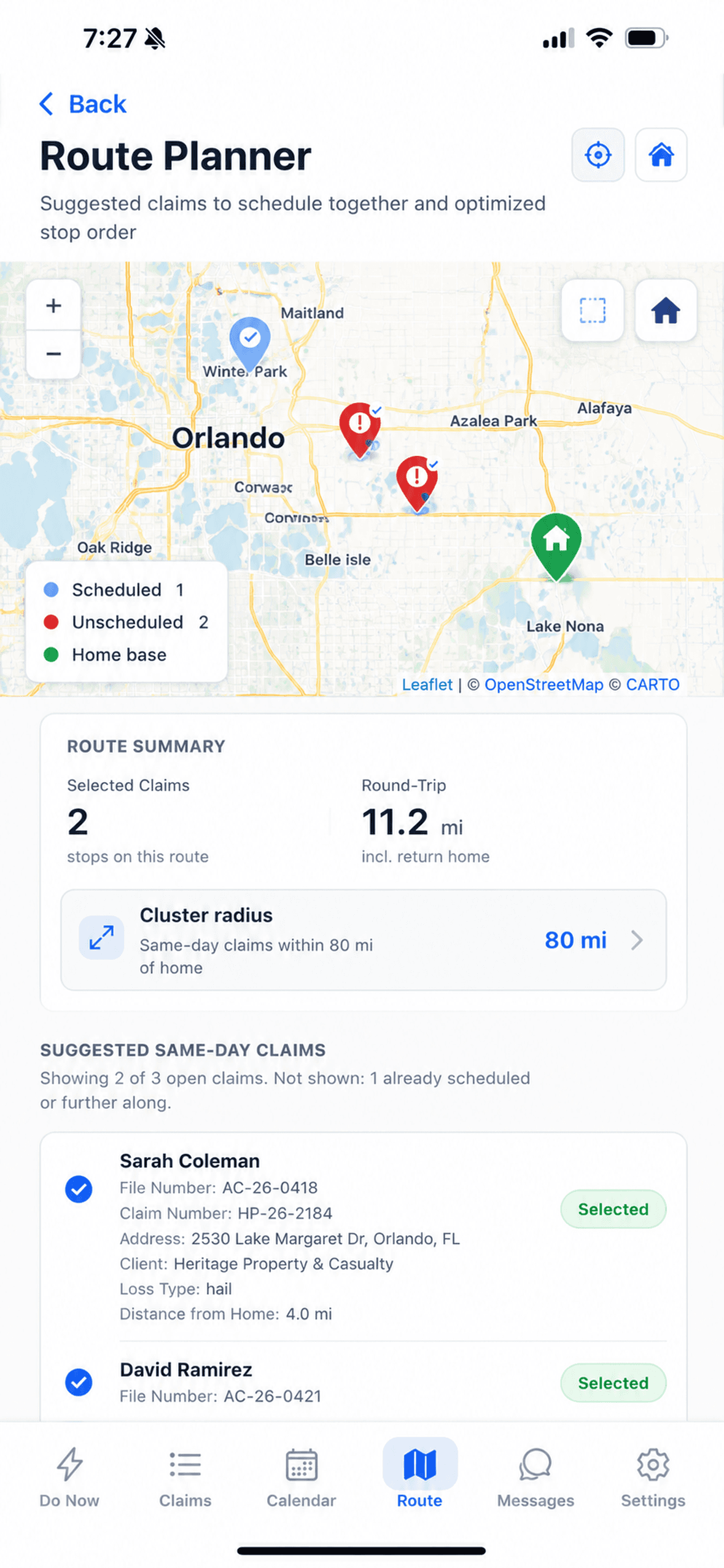
Every claim with a saved location shows up together — scheduled and unscheduled — so you can see the shape of the day before you drive it.
See the day's mapped claims together, group the stops that are close, build a suggested order from where you're starting, and change it when the day changes.
Product screenshots use synthetic demonstration claims.
Built around one adjuster and the claims actually in front of them.
Every claim with a saved location shows up together — scheduled and unscheduled — so you can see the shape of the day before you drive it.
Claims near each other cluster inside a radius you set, anywhere from 5 to 100 miles, so a day's stops hang together.
Choose the claims you're taking and the planner sequences them from your starting point, with leg detail and a round-trip estimate.
Move stops when an appointment or local knowledge should win — and bring back the suggested order whenever you want it.
Pick a date and start time, preview the appointment sequence, and save those times to your calendar.
Send the route to Apple Maps, Google Maps, or Waze. Google Maps takes the full multi-stop route; the others take your next stop.
Scheduled work, unscheduled work, your starting point, and the stops you've picked — all in one view.
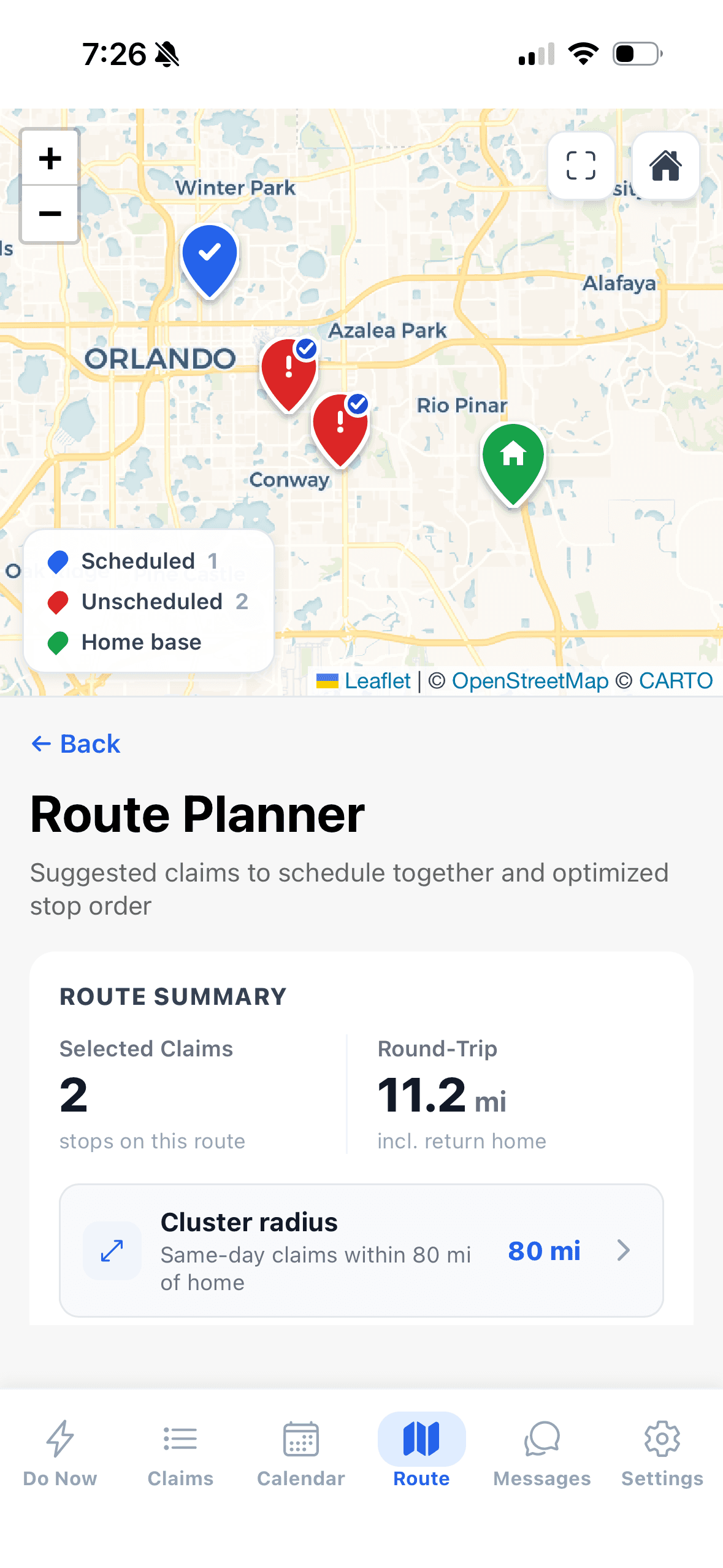
Claims with a saved location plot together, so scheduled and unscheduled work sit side by side.
Add or remove suggested claims before the sequence gets built.
Nearby claims cluster inside the radius you set — 5 to 100 miles, your call.
Six steps, and the route stays editable through every one of them.
Open the planner and the field work waiting on you appears on one map, scheduled and unscheduled together.
Add or drop claims until the list matches the day you actually intend to work.
Generate a stop sequence from your starting point, then review each leg and the round-trip estimate.
Move stops when an appointment time or local knowledge should win. Restore the suggested order any time.
Choose a date and start time, preview the sequence, and save those appointment times to the calendar.
Open your next stop — or the whole route in Google Maps — and go.
Review the sequence, move what needs moving, save the times you intend, and open navigation however you like.
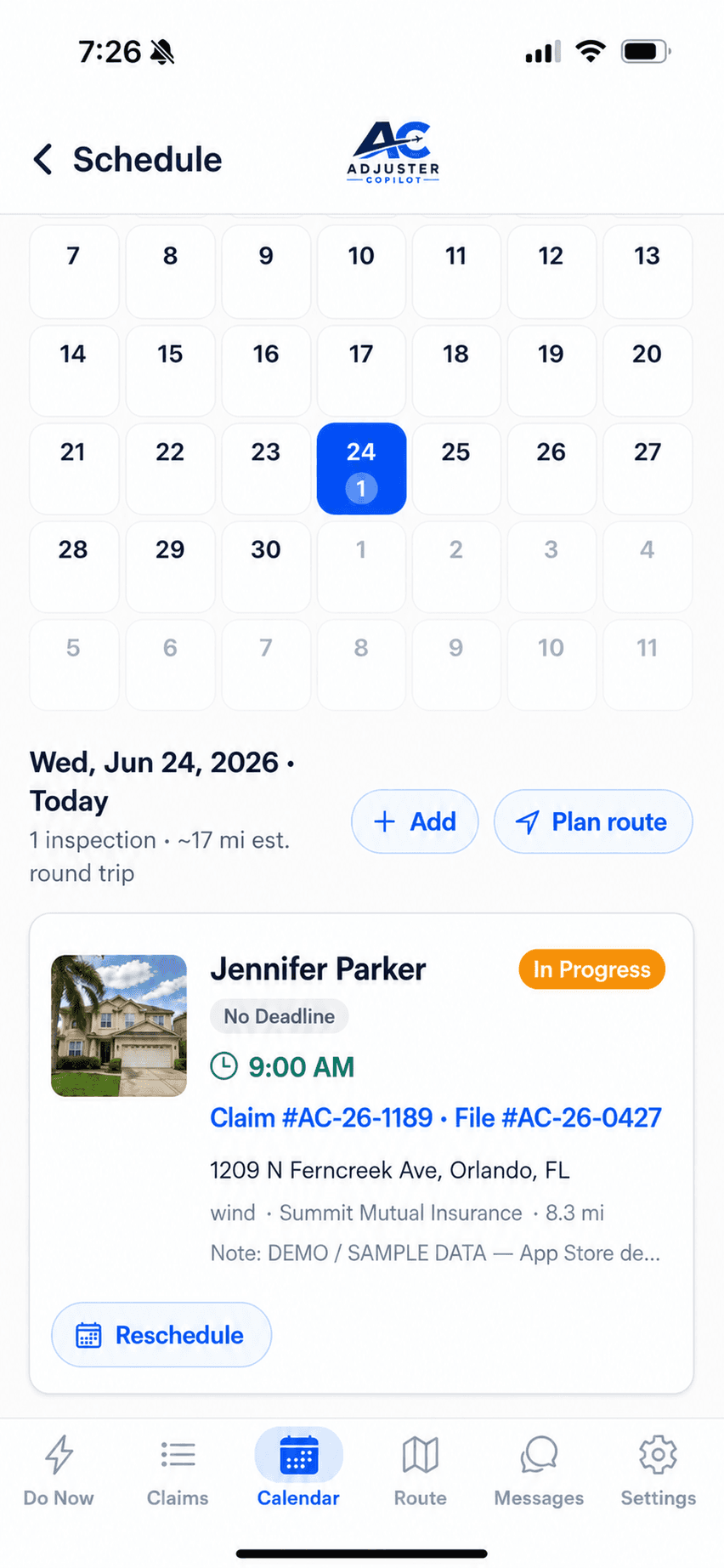
Pick a date and start time, preview the proposed sequence, and save it. Any single inspection can still be rescheduled with the usual date-and-time picker.
Send a destination straight to Apple Maps, Google Maps, or Waze. Google Maps takes the full multi-stop route; Apple Maps and Waze take your next stop.
On a CAT deployment the day starts somewhere temporary. Set that address as the routing origin and the planner builds around where you actually are.
Download the day's assignments before you leave coverage and the inspection keeps going — answers, notes, and photos save on the device and sync when you're back in range.
See how offline worksStart a trial and build one real route — pick the stops, take the suggested order, move what you want, and send it to your maps app.